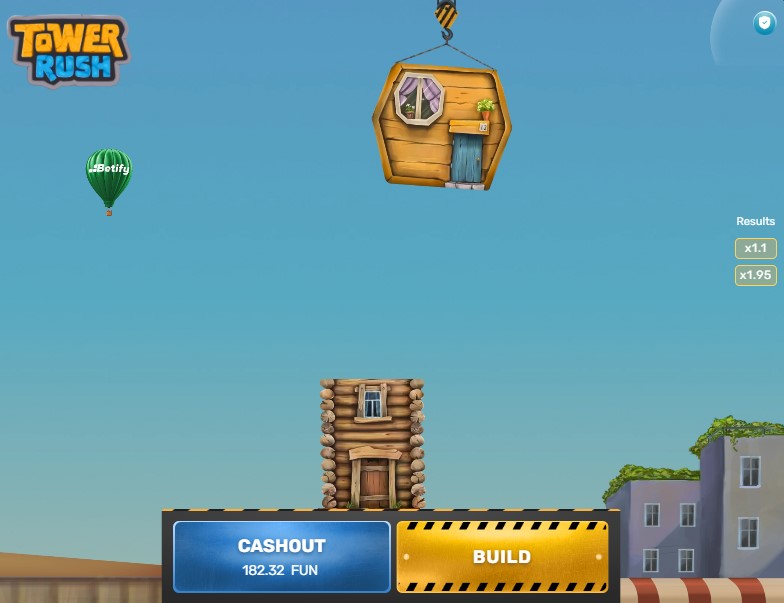
The in-game bonus adjustment
The three in-game bonuses of Tower Rush change the optimal cashout decision within a round. Those who can react to bonuses have an advantage over auto cashout players.
Frozen Floor appears:The block is automatically placed perfectly. This provides security for the next level. If the planned cashout was at x4 and the Frozen Floor appears on level 6: Move the cashout to x5 or x6. The secured level gives a buffer for one or two more manual placements.
Temple Floor appears:The multiplier for this level is significantly increased. If the planned cashout was at x4 and a Temple Floor jumps the multiplier from x3.5 to x6: Cash out immediately. The Temple Floor has exceeded the planned profit — there is no reason to risk further. Greed for the Temple Floor is one of the most common mistakes.
Triple Build appears:Three levels are built simultaneously. The multiplier jumps drastically. If the planned cashout was at x4 and a Triple Build catapults the multiplier from x3 to x8: Cash out. The Triple Build is a gift — accept the gift, don’t wait for something bigger.
The basic rule for in-game bonuses: If the bonus reaches or exceeds the planned cashout value, cash out immediately. If the bonus has not yet reached the cashout value, adjust the plan and aim for one or two more levels.
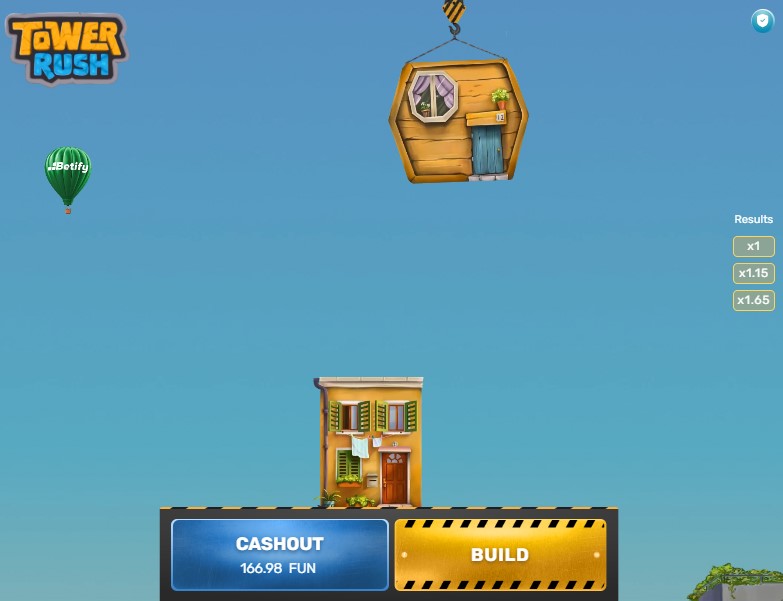
Why cashout is more important than block placement
Block placement determines how high the tower can go. Cashout determines whether you benefit from the tower. A player with perfect timing who always cashes out too late loses more than a player with mediocre timing who disciplinedly exits at x4.
The math behind it: A player who wins in 40% of their rounds and cashes out at an average of x4 generates a return of 4 × 4 € = 16 € per 10 rounds (at 1 €), minus 10 € bet = +6 €. A player who wins in 25% of their rounds because they aim higher but cashes out at x8 generates 2.5 × 8 € = 20 €, minus 10 € = +10 €.
Sounds like the aggressive cashout is better? Only on paper. In practice, the variance with x8 cashout is significantly higher. The player experiences longer losing streaks (five, six, seven rounds without a win), which are psychologically taxing and lead to impulsive bet increases. The x4 cashout player has more stable sessions, fewer emotional swings, and makes better long-term decisions.
The optimal cashout is where mathematical return and psychological stability are in balance. For most players, this is x3–x6.
Every player has a natural cashout tendency. Recognizing your own tendency is the first step to improvement.
The Anxious (x1.2–x2).Cashes out immediately as soon as there is a small win. Wins often, but the winnings are too small to compensate for the inevitable losses. Long-term slightly in the negative, because the average win is below the break-even point.
The Cautious (x2–x3).Waits for a solid but not spectacular multiplier. Wins regularly and keeps the budget stable. Rarely large wins, but also rarely dramatic losses. Profile: long-term close to RTP.
The Balanced (x3–x6).The Sweet Spot. Enough multiplier to compensate for losses, not so much that the win frequency collapses. Most successful long-term players fall into this category.
The Risk-Taker (x6–x15).Aims for the middle to upper floors. Wins less frequently, but the winnings are substantial. Requires a larger budget to withstand losing streaks. Profile: volatile sessions with high profit or loss potential.
The Maximizer (x15–x100).Waits for the big multiplier. Loses in 85–95% of rounds, but a single hit can compensate for an entire week. Requires an enormous budget, maximum patience, and the ability to endure many losses in a row. Not for beginners.
| Type | Cashout Range | Win Frequency | Variance | Budget Requirement | Suitability |
|---|---|---|---|---|---|
| Anxious | x1.2–x2 | ~75% | Very low | Low | Beginners (temporary) |
| Cautious | x2–x3 | ~55% | Low | Low | Conservative players |
| Balanced | x3–x6 | ~35–45% | Medium | Medium | Most players |
| Risk-Taker | x6–x15 | ~15–20% | High | High | Experienced players |
| Maximizer | x15–x100 | ~3–8% | Very high | Very high | High rollers |
Tower Rush offers an auto-cashout feature. You set a multiplier before the round, and the game automatically cashes out as soon as that value is reached. No manual pressing, no emotional hesitation.
Advantages of auto-cashout:Perfect discipline. No "one more level" impulse. No missed cashouts due to distraction or nervousness. Ideal for players who know they make poor decisions in the heat of the moment.
Disadvantages of auto-cashout:No response to in-game bonuses. If the auto cashout is set to x4 and a Temple Floor at level 7 pushes the multiplier to x6, the system still cashes out at x4 — the bonus advantage is wasted. Additionally, the auto cashout eliminates the skill factor in the cashout decision.
Our recommendation:Auto cashout for beginners (to learn discipline) and for casual sessions (when doing something else on the side). Manual cashout for focused sessions where you want to respond to in-game bonuses.
| Situation | Recommendation |
|---|---|
| Beginners (first 50 rounds) | Auto cashout at x3–x4 |
| Focused session | Manual cashout with pre-round method |
| Casual session (on the side) | Auto cashout at x2.5–x3 |
| Bonus hunting (responding to in-game bonuses) | Manual cashout, flexible plan |
| Aggressive strategy | Auto cashout at x8–x10 with a large budget |
Cashout mistakes cost more money than mistakes in block placement. Here are the five most expensive mistakes and how to avoid them.
Mistake 1: No plan.Going into the round without a set cashout point. This leads to spontaneous decisions under pressure. Avoidance: Set the cashout point before each round.
Mistake 2: Changing the plan.Wanting to cash out at x4, then thinking “it's going well, I'll go for x8” and losing the tower at x6. The profit of x4 turns into a loss. Avoidance: Stick to the plan. Exception only for in-game bonuses.
Mistake 3: Staring at the multiplier.Those who look at the number at x8 instead of the block miss the next placement timing. The tower falls, and the x8 profit is gone. Avoidance: Look at the block, not the number. The multiplier is relevant at cashout, not during building.
Mistake 4: Trying to compensate for previous losses.Losing three rounds, now waiting for x10 to make up for everything. This is chasing losses — the most common cause of rapid budget loss. Avoidance: Treat each round independently of the previous one. The same cashout plan, regardless of whether the last round was won or lost.
Mistake 5: Lowering the cashout point after a big win.Achieving a x15 win, feeling confident, and cashing out the next ten rounds at x1.5 to "secure the profit." This is too conservative — x1.5 cashouts do not compensate for losses in the long run. Avoidance: Maintain the same cashout plan, regardless of the previous outcome.
A technique from the trading world, adapted for Tower Rush: Document each round and analyze the cashout decisions.
Format (simple table or note app):
Round, stake, planned cashout, actual cashout, reason for deviation, result.
An example entry: Round 47, €1, planned x4, actual x6.2 (Temple Floor adjustment), profit +€5.20. Or: Round 48, €1, planned x4, actual x7 (greed), tower fell, loss -€1.
After 20–30 documented rounds, patterns emerge. How often do I deviate from the plan? How often does the deviation lead to better results? How often to worse ones? Most players find that deviations from the plan lead to losses more often than to gains — a sobering but valuable insight.
The cashout diary is a hassle — but it’s the fastest way to improve your cashout discipline.
⭐⭐⭐⭐⭐ (5/5) — “The pre-round method has completely changed my game. Before, every round was an emotional chaos — should I cash out at x3? Or x5? Or x8? Now I tell myself before the round ‘x4’, and when x4 comes, I press immediately. No thinking, no hesitation. My results have been significantly more stable since then.” — David L., Stuttgart, January 2026
⭐⭐⭐⭐ (4/5) — “Auto-cashout at x3.5 was a game-changer for me. I knew I was too emotional manually — at x5 I always wanted to go further. The auto-cashout takes the decision away from me, and my balance grows slowly but steadily. The only downside: I miss the Temple Floor bonuses because the system cashes out at x3.5, even when the bonus pushes the multiplier to x7.” — Nina H., Zurich, February 2026
⭐⭐⭐⭐ (4/5) — “My most expensive mistake: not cashing out at x18 because I wanted x20. The tower fell at level 16. €18 profit (with a €1 stake) gone. Since then, my rule is: if the multiplier exceeds my target by 50%, I cash out immediately. If my target is x6 and the multiplier is at x9 — cash out. No ifs or buts.” — Julian F., Berlin, March 2026
⭐⭐⭐ (3/5) — “The cashout diary is exhausting, but it works. After 50 rounds, I saw that in 70% of the cases where I deviated from the plan, I was worse off. Since then, I stick to the plan. My average profit per round has risen from x2.8 to x3.6 — simply because I make fewer mistakes.” — Sabrina K., Graz, February 2026

FAQ
x3–x6 for most players. Conservative: x2–x3. Aggressive: x8–x15. The optimal point depends on the budget, risk tolerance, and emotional stability.
Auto-cashout for discipline and casual sessions. Manual for focused play with bonus reaction. Beginners: start with auto-cashout, then gradually switch to manual.
Frozen Floor: aim for 1–2 more levels. Temple Floor: cash out immediately when the multiplier exceeds the plan. Triple Build: cash out immediately — accept the gift.
Only for in-game bonuses. In all other cases: stick to the plan. Discipline beats intuition in Tower Rush.
Yes. It reveals patterns that you wouldn’t notice without documentation — for example, that deviations from the plan lead to losses more often than to gains.
Yes. Test different cashout strategies in demo mode (20 rounds at x3, 20 rounds at x5, 20 rounds at x8) and compare the results. This way, you find your personal sweet spot.
Our conclusion
Cashout is the crucial skill in Tower Rush — more important than block placement, more important than bet size. Those who master the cashout control the game. Those who do not will be controlled by the game.
The three most important techniques: First, set the cashout point before the round (pre-round method). Second, respond to in-game bonuses but stick to the plan otherwise. Third, document and analyze your own decisions (cashout diary).
Tower Rush gives the player control — but only if they use it. The tower will always fall. The question is only whether you pressed the cashout button beforehand.
Rating: 4.5/5
Gambling carries risks. Winnings are never guaranteed. Only bet money you can afford to lose. If you have problematic gambling behavior, contact the BZgA: 0800 1 37 27 00 (free).
The Pre-Round Method
The most effective technique for better cashout decisions: Set the multiplier before the round, not during the round.
During the round, the player is under pressure. The tower grows, the multiplier rises, the tension is real. In this moment, the brain makes emotional decisions — influenced by greed (one more floor!), fear (cash out now!), or euphoria (this will be a x20!). None of these emotions lead to optimal results.
Before the round, the mind is clear. No block is hovering, no multiplier is flashing. You can decide rationally: "I will cash out this round at x4." Then the round starts, and when x4 is reached, you press the cashout button — without thinking, without hesitation, without discussion with yourself.
The trick works because it separates the decision from the emotion. The decision is made in a calm moment. The execution happens in an exciting moment. The decision remains rational nonetheless.
Exception: If an in-game bonus (Temple Floor, Triple Build) unexpectedly increases the multiplier, an upward adjustment of the cashout point is justified. A Temple Floor on level 8 that catapults the multiplier from x4 to x7 deserves a shift in the plan from x4 to x7. But this is a conscious adjustment, not an emotional reaction.